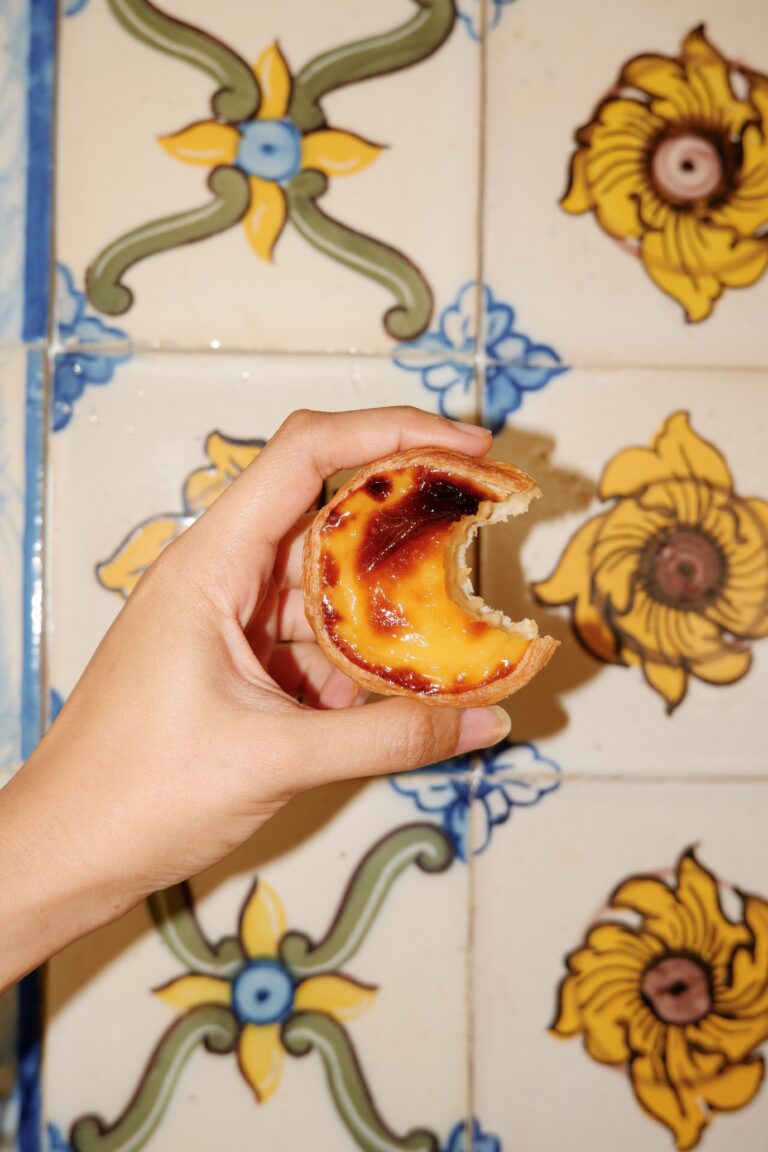
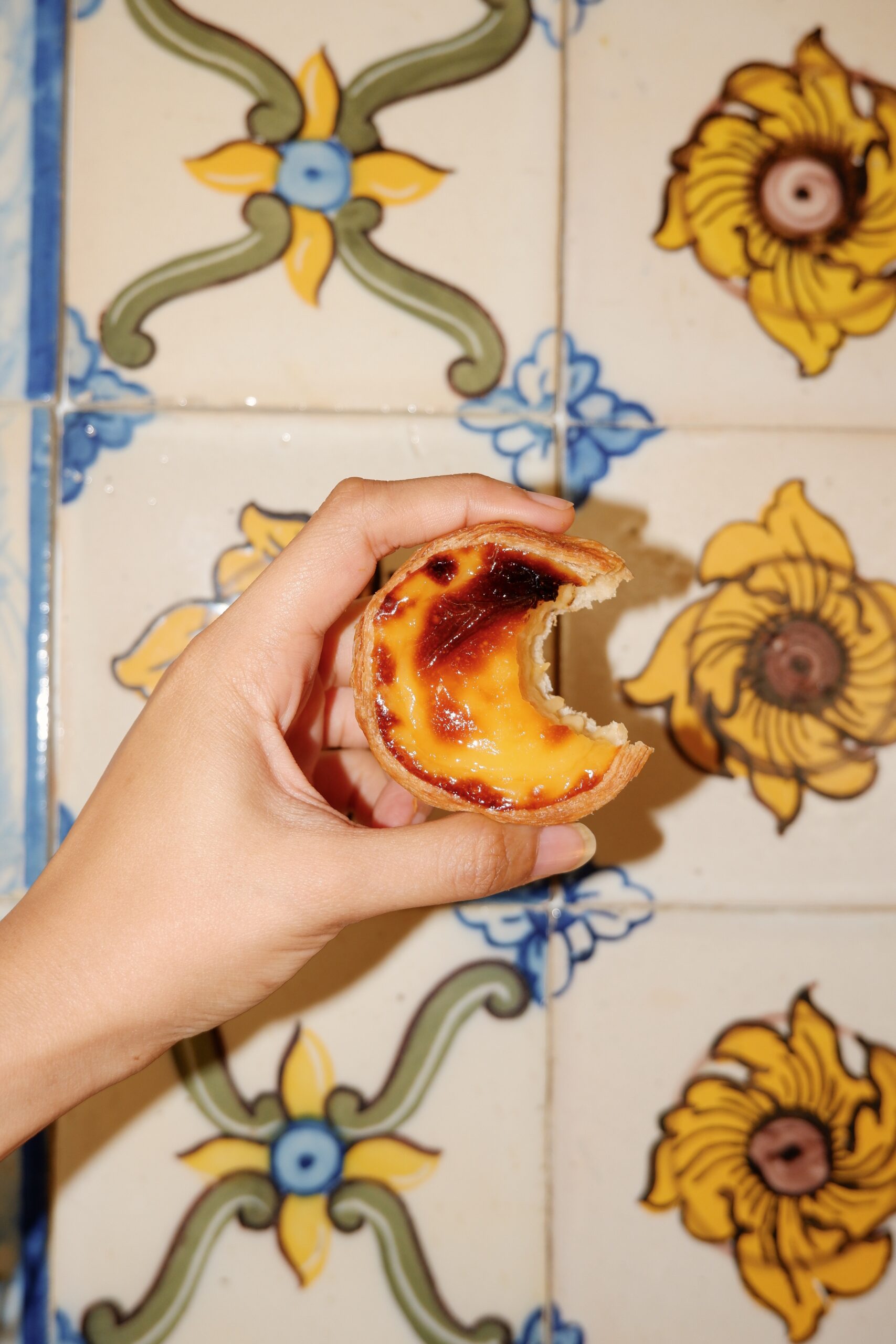
They sit side by side in the glass case, two golden tarts about the same size, and people point at them as if they were twins. They are not twins. They are not even cousins, really — more like two strangers who happen to share a coat. One was born in a Lisbon monastery; the other in a Guangzhou tea house. The differences run all the way down to the pastry.
What actually separates the two?
The short answer: the crust, the custard, and the colour on top.
A pastel de nata is built on laminated pastry — dough folded with butter, again and again, the way you’d make a croissant. When it bakes, those layers shatter into dozens of thin, crackling sheets. The Hong Kong egg tart sits in a shortcrust shell, sometimes a sweeter cookie-style dough, dense and biscuity, holding its shape like a little bowl.
Then the custard. The Portuguese filling is heavier with egg yolk and cream, cooked twice — once on the stove as a thick base, once in a furnace-hot oven that scorches the surface. The Hong Kong filling is lighter, smoother, almost a steamed-egg texture, poured raw and baked gently so it stays a flawless, glassy yellow.
And the top. This is the giveaway. One is blistered and burnt in places. The other is smooth and pale gold, no scorch marks anywhere.
Why is the Portuguese tart burnt on top?
People who grew up on the Hong Kong version sometimes flinch at their first pastel de nata. Those black-brown spots look, to the uninitiated, like a mistake. They are the whole point.
The blistering comes from heat — real heat, often 250°C or higher, sometimes pushed past 300°C in the old Lisbon ovens. The sugar and egg on the custard’s surface caramelise and char in seconds, the way the top of a crème brûlée does under a torch. That bitterness is deliberate. It cuts the richness underneath, so the tart tastes balanced rather than cloying.
The Hong Kong egg tart goes the other way. Lower oven, longer bake, custard protected so it never browns. The flavour aims for clean and eggy, almost custard-pudding territory — comforting, gentle, the taste of a Cantonese cha chaan teng on a slow afternoon. Neither is better. They simply want different things. One wants contrast; the other wants smoothness.
Where did each one come from?
The pastel de nata traces to the Jerónimos Monastery in Belém, on the western edge of Lisbon, before the 18th century was out. Monks used egg whites to starch their habits and were left with mountains of yolks, so they baked tarts. When the monasteries were shuttered in the 1830s, the recipe passed to a nearby sugar refinery, and the shop that became Pastéis de Belém has guarded its version since 1837. Everywhere else in Portugal, the tart is simply a pastel de nata; only that one shop may call its tarts pastéis de Belém.
The Hong Kong egg tart arrived a century later and by a stranger road. Custard tarts came to Canton through Western trade, were reworked in 1940s tea houses, and then crossed into Hong Kong’s cha chaan teng and dim sum trolleys. Some food historians point to the English custard tart as the ancestor; others to Portuguese influence filtering up through Macau. Either way, by the time it reached Hong Kong it had become its own thing — smaller, smoother, unmistakably Cantonese.
Where Bartolo fits in
We make the Lisbon kind. That means laminated pastry, cold-proofed before it ever sees the oven, and a custard cooked hot enough to blister the tops — the burnt freckles, not in spite of them. A single pastel de nata is RM 6 at our counter, and we’d gently suggest eating it warm, within the hour, with a short black coffee — what the Portuguese call a bica.
You’ll find us in two places. The flagship sits inside Central Market in central Kuala Lumpur, where the bakery shares a roof with our jazz nights and salsa floor. The second is a kiosk at Bangsar Shopping Centre, Nata House, built for people who want a box to go. The full range — natas, pastéis of other kinds, and the petiscos beside them — lives on our menu. If you’re coming as a group or want a tray for an office, message us on WhatsApp and we’ll set it aside. For opening hours and directions to either spot, see visit us.
Frequently asked questions
Is a pastel de nata the same as a Portuguese egg tart? Yes — they’re two names for the same thing. Pastel de nata (plural pastéis de nata) is the Portuguese term; “Portuguese egg tart” is the English description English speakers reach for. Both mean the laminated-pastry, blistered-top, twice-cooked custard tart from Lisbon. The only narrower name is pastéis de Belém, which by tradition belongs solely to the original shop in the Belém district.
Which is sweeter, the Portuguese or the Hong Kong tart? Neither is dramatically sweeter on paper, but they read differently. The Portuguese tart tastes richer because of the extra egg yolk and cream, with the burnt top adding a bitter edge that balances it. The Hong Kong egg tart tastes cleaner and lighter, its sweetness more even and its texture softer. If you prefer contrast and caramel notes, go Portuguese; if you prefer smooth and mellow, go Hong Kong.
Can you eat a pastel de nata cold? You can, but you’d be missing most of it. The pastry is at its best warm, when the layers are still crisp and the custard is loose and trembling. Cold, the butter in the laminated crust firms up and the texture turns waxy. We bake in batches through the day so the counter tarts are fresh — ask for a warm one, and if it’s been sitting, most places (us included) are happy to give it a few seconds of heat.
Why do Hong Kong egg tarts have a smoother top? Because they’re baked at a lower temperature and the custard is shielded from direct, scorching heat. The egg mixture is also strained and lighter, with less to caramelise on the surface. The result is that glassy, even, pale-gold finish — no blistering, no char. It’s a deliberate choice that matches the Cantonese taste for a clean, gentle custard rather than the Portuguese taste for burnt contrast.